EU AI Act enforcement priorities for UK organisations in 2026
AI-assisted editorial content. Source links are provided for verification. Read our AI disclosure.
Executive summary
The implementation of the EU AI Act marks a pivotal milestone for global technology governance. For UK organisations developing or deploying artificial intelligence that impacts EU citizens, scope must be assessed against the organisation's role and the way the system or its output is used.
Understanding Extraterritorial Obligations
Article 2 of the EU AI Act establishes that the regulation applies to providers placing AI systems on the EU market or whose output is used within the Union. UK boardrooms must assess whether their models touch EU markets.
Compliance requires proactive technical documentation rather than reactive assurances.
Operating successfully within this rigorous EU legislative regime requires British engineering and legal teams to establish verifiable traceability across every training pipeline. Unlike the UK's principles-based, pro-innovation regulatory framework administered by sector regulators, the European Union enforces strict, prescriptive requirements accompanied by severe statutory penalties for non-compliance. Consequently, UK exporters must map their internal data governance practices directly to European harmonised standards, identifying which conformity assessment, logging and oversight obligations apply to the particular system and when they become applicable.
Our EU AI Act guidance provides a starting point for mapping these obligations to your organisation.
Commercial procurement contracts may include AI compliance warranties. The implications of documentation or oversight gaps depend on the contract, the applicable law and the system's use. To safeguard enterprise valuation and maintain uninterrupted access to the European single market, UK leadership must elevate AI governance from an IT compliance afterthought to a foundational board-level strategic imperative.
Key Compliance Milestones
- High-Risk Classification: Map all deployed models against Annex III categories.
- Conformity Assessments: Determine the applicable conformity procedure; third-party assessment is not universal.
- Human Oversight: Implement operational kill switches and review checkpoints.
| Risk Tier | Primary Obligation | Potential Penalty |
|---|---|---|
| Unacceptable | Prohibited deployment | Up to €35M or 7% global turnover |
| High-Risk | Conformity assessment & logging | Up to €15M or 3% global turnover |
| Transparency obligations | Assess the relevant Article 50 disclosure duties | Check the applicable legal provision |
| Minimal risk | No additional AI Act duties solely because of this category | Other applicable laws still need assessment |
By establishing rigorous internal controls today, leadership teams protect both enterprise valuation and customer trust.
Check the current timetable before planning
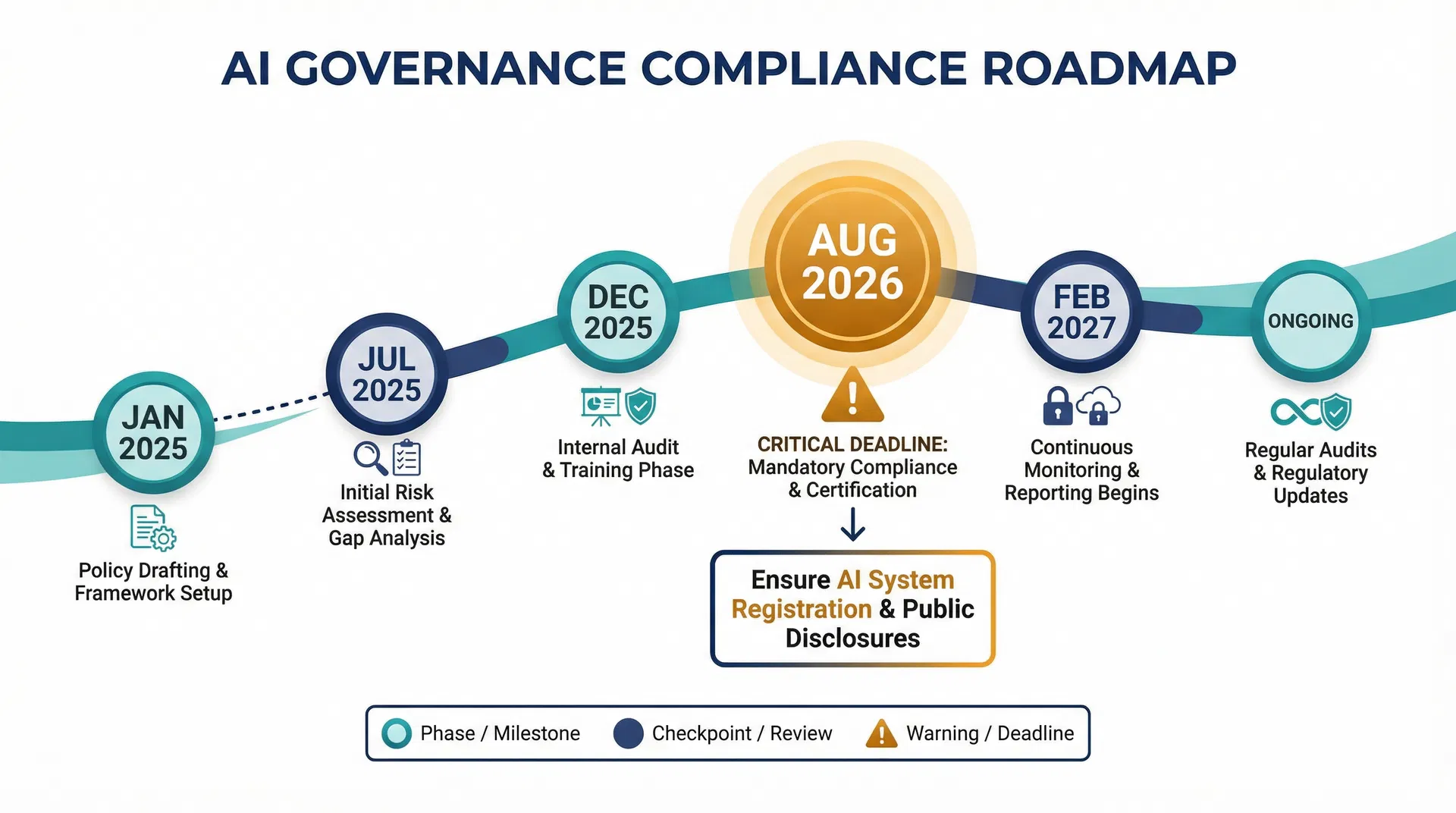
The European Commission's current AI Act overview, checked on 5 November 2026, distinguishes the general application date from the transition periods for high-risk systems. It describes Annex III high-risk rules applying from 2 December 2027 and rules for high-risk systems embedded in regulated products applying from 2 August 2028 following the AI Omnibus changes. Transparency obligations are a separate question. Do not treat 2 August 2026 as a universal deadline for every category of AI system or assume that a transition period removes all other obligations.
Teams assessing their readiness can use the free governance resources to structure the next review.
Document your role and the actual use case
Begin with the intended use and your organisation's role in the supply chain. A UK company may develop a system, buy a system for its own operations or integrate a model into a wider product. Those roles can lead to different questions about the applicable obligations. Record where the product is offered and where its output is used. Avoid deciding applicability solely from a supplier's marketing label. If the boundary is unclear, seek qualified advice and retain the reasoning behind the conclusion.
Build an evidence register that records the system version, intended purpose, relevant data sources and available supplier documentation. Separate the information you control from the information you need to request. This helps procurement and engineering staff make realistic plans rather than assuming that a vendor will provide every document at the last moment. Keep a named owner for each outstanding item and an agreed route for resolving gaps that could affect the decision to deploy. The register should connect to the operational system, not remain an isolated compliance spreadsheet.
Review change and oversight together
A new purpose, a changed customer population or a significant system modification can alter the assessment. Include a checkpoint in the change process so the responsible team can revisit the legal analysis and supporting tests before release. Human oversight should also be designed for the workflow. Staff need an understandable account of limitations and a practical route to intervene. A theoretical ability to stop a system is not useful if the person responsible cannot identify when intervention is needed or lacks authority to pause the process.
A governance workshop can help turn an identified compliance gap into an owned action plan.
The Commission's overview describes risk assessment, documentation, logging, human oversight and other controls for high-risk systems. Their application should be assessed against the current legal text and the actual system category. This article provides a planning perspective, not legal advice or a determination that your organisation is compliant. Verify source guidance before making contractual commitments, and avoid promising a universal third-party certification route where the applicable conformity procedure has not yet been established for your use case.
(C) 2026 | All rights Reserved.
Subjects
Cite this article
Gary A. Murrain-Meade FiTOL. “EU AI Act enforcement priorities for UK organisations in 2026.” Verus AI Compass Blog, 19 August 2026.
All articles